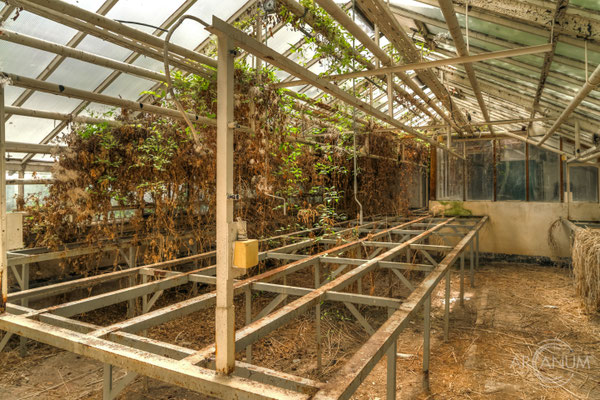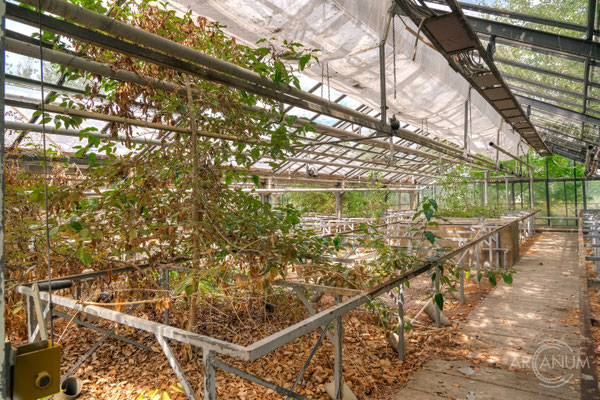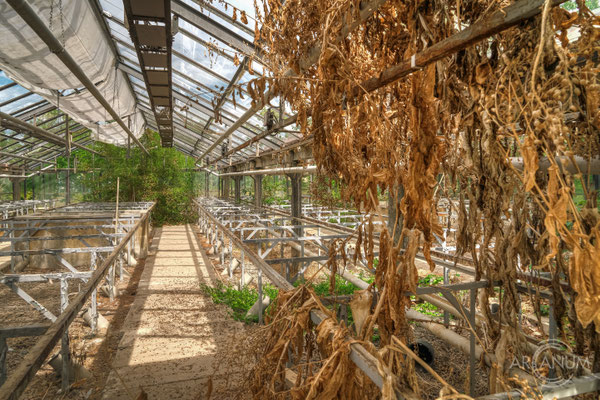
Research Facility "Jungle Institute"
The Institute for Phytopathology was founded in 1920 as a regional branch of the Biological Reich Institute for Agriculture and Forestry. Its original mandate was applied research on plant diseases affecting agricultural and horticultural crops, with a focus on diagnosis, epidemiology, and control measures. In its early phase, the institute operated with limited staff and infrastructure, conducting mainly practical investigations related to vegetable production.

Early Years
During the 1920s, the institute expanded its activities and facilities, including laboratory and greenhouse capacities. Research topics at this time included insect pests, seed-borne pathogens, and physiological plant disorders. Increasing attention was paid to diseases whose causes were not yet fully understood, particularly those later identified as virus-induced.
Reorientation after World War II
A significant reorganization took place after World War II. Under new leadership, the institute was rebuilt and strategically developed with a strong emphasis on plant virology. This focus distinguished it from many comparable institutions and became a defining element of its scientific profile. Research concentrated on the identification, characterization, and transmission of plant viruses, including studies on insect vectors, especially aphids.
Institutional Expansion and Integration (1950s–1960s)
In the 1950s, the institute was incorporated into the national Academy of Agricultural Sciences. This integration led to substantial growth in personnel, infrastructure, and research capacity. Several specialized departments were established, covering plant virology, entomology, microbiology, and later mycology and bacteriology.
Methodological advances played an important role during this period. In particular, serological and other diagnostic techniques for virus detection were developed and applied in agricultural practice. Some of these diagnostic tools were produced on a larger scale and distributed nationally and internationally.
Scientific Profile and Research Output (1960s–1980s)
From the 1960s through the 1980s, the institute developed into one of the leading research centers for plant virus diseases in Central and Eastern Europe. Its work combined basic research on pathogens and vectors with applied studies aimed at plant protection and crop health. At its peak, the institute employed several hundred staff members and maintained extensive laboratory, greenhouse, and experimental field facilities.
Notable Research Contributions
The institute achieved particular recognition for its contributions to plant virology. These included advances in the identification and classification of economically important plant viruses and in the understanding of virus transmission mechanisms, especially those involving aphid vectors. Researchers contributed to the differentiation of transmission modes and established experimental systems that were widely referenced in phytopathological research.
Another key achievement was the development and application of serological diagnostic methods for plant virus detection. These methods enabled early, reliable diagnosis and were integrated into plant protection programs. By linking fundamental research with practical applications, the institute made lasting contributions to integrated plant protection strategies.
Dissolution and Legacy (1990s)
Following political and institutional restructuring in the early 1990s, the institute was dissolved as an independent entity. Its research groups and responsibilities were transferred to successor organizations within the federal agricultural research system. Over subsequent years, these units were relocated and consolidated into new institutional frameworks, bringing the independent history of the institute to an end.
Visited: August 15, 2021
Location: Undisclosed, Germany
Status: Abandoned