WWII Observation Bunker
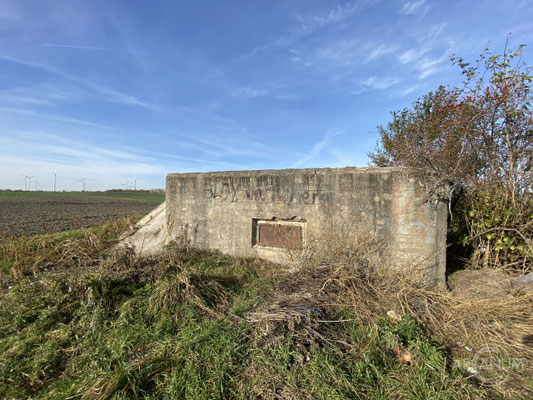
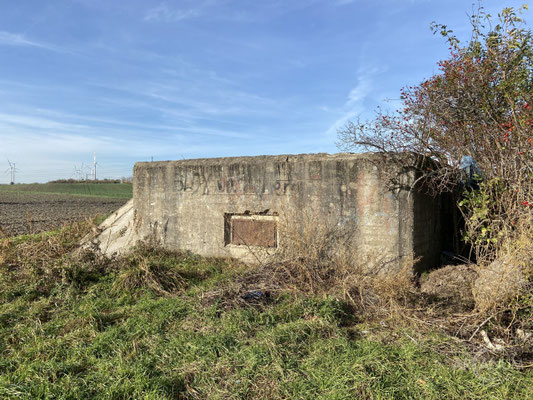
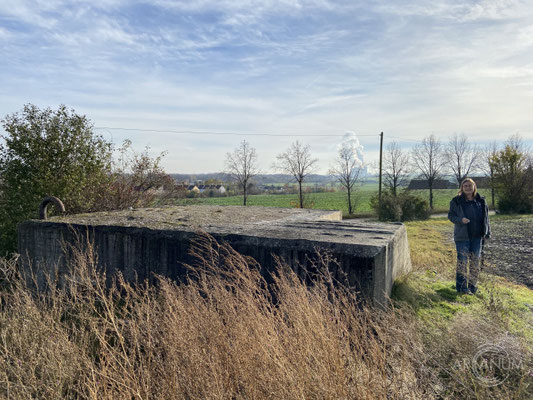
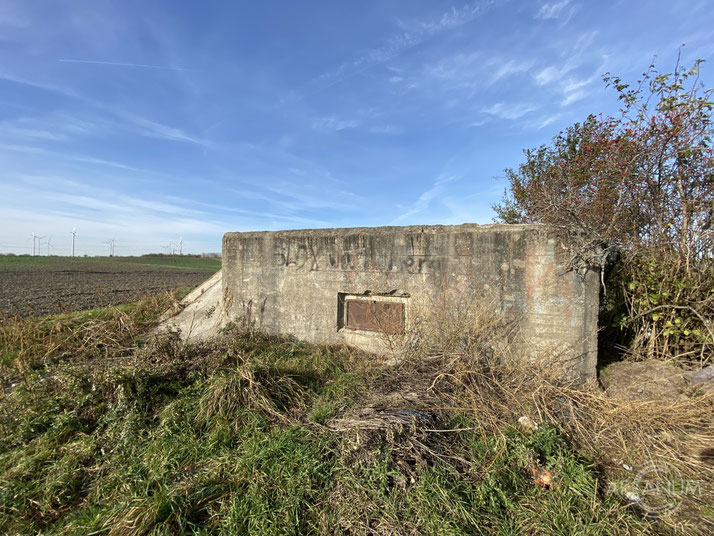
The small bunker located on the hill west of Holleben, near Halle (Saale) in Saxony-Anhalt, Germany, is generally believed to date from the final years of the Second World War, although no surviving construction records have yet been identified to conclusively confirm its origin. Based on its location, design, and the historical context of the surrounding area, the most plausible interpretation is that it served as a Luftwaffe observation and fire-control position within the air-defense network protecting the nearby Buna Works at Schkopau.
During the Second World War, the Buna Works were among Germany's most important industrial facilities, producing synthetic rubber and other strategically vital materials. As a result, the complex became a frequent target of Allied bombing raids and was surrounded by a dense network of anti-aircraft defenses. The elevated position of the Holleben bunker would have provided an excellent vantage point over the surrounding landscape and industrial area, making it well suited for observation, target tracking, and coordination of nearby anti-aircraft batteries. Local accounts associate the site with flak positions in the Holleben and Benkendorf area, including heavy railway-mounted anti-aircraft guns deployed to defend the industrial zone.
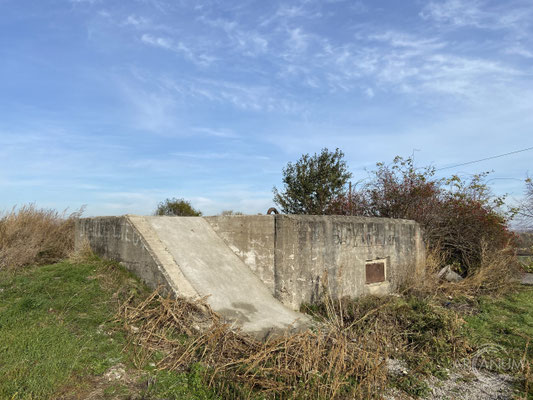
The bunker itself is relatively small, measuring approximately six by five meters with only a limited internal space. These dimensions are more consistent with a wartime observation or fire-control post than with the larger command bunkers and civil-defense shelters typically constructed during the Cold War. This architectural evidence further supports the theory that the structure originated during the Second World War rather than during the period of the German Democratic Republic (GDR), as some sources suggest.
The site's history did not necessarily end in 1945. During the Cold War, the area around Holleben was used by the National People's Army (NVA) of East Germany, particularly in connection with the 11th Motor Rifle Division. Local sources report that the bunker and its surrounding hill were occasionally used as observation points during military exercises. The location is also said to have attracted the attention of the French Military Liaison Mission, one of several Western Allied missions operating in East Germany to observe Warsaw Pact troop movements and military activities. According to local accounts, French observers reportedly used the elevated position of the bunker to monitor NVA exercises in the area.
These military associations have led some sources to describe the bunker as a Cold War or East German military structure. However, there is currently no strong evidence that the bunker itself was constructed by the NVA or the East German civil-defense system. Instead, the available information suggests a more likely sequence in which a wartime observation bunker survived the end of the Second World War and was subsequently reused, or at least exploited as a convenient observation point, during the Cold War.
Despite the strong circumstantial evidence supporting a Second World War origin, some uncertainty remains. The exact construction date has not yet been verified through archival records or wartime aerial photography. Future analysis of Allied reconnaissance photographs from 1944–1945 could potentially confirm whether the bunker already existed during the war. Until such evidence is found, the identification of the structure as a Luftwaffe observation and fire-control bunker should be regarded as the most probable interpretation rather than an established fact.
Today, the bunker stands as a small but intriguing relic overlooking the countryside near Holleben, reflecting both the air war over central Germany and the later military history of the Cold War. Its surviving structure offers a rare glimpse into a landscape shaped first by the defense of the Buna industrial complex and later by the military tensions that divided Europe for decades.
Visited: November 10, 2021
Location: Holleben (Teutschenthal), Germany
Status: Abandoned, sealed